

Sixthfin Financial Close Automation Software 2026: Close Review and Control Layer Targets the Gap Between Completing the Close and Reviewing Its Output in UK Multi-ERP Enterprises
A UK enterprise may already run workflow or close management software while still conducting analytical review, account justification and investigation through spreadsheets. Closing provides enterprise finance teams with a financial review and control layer across existing ERP systems, built around that review and control requirement. Sixthfin technology supports 38 ERP systems and is deployed in more than 70 countries.
London, United Kingdom, Oct. 26, 2026 (GLOBE NEWSWIRE) -- Two UK finance functions can buy close software in the same year and be solving different problems. One is struggling with ownership, deadlines and task coordination. The other completes the close on time but lacks the capacity to analyse, justify and investigate the information produced. Sixthfin, a financial data control and financial close technology company with offices in London and Paris, built its Closing platform around the second requirement. For more information visit https://sixthfin.com/en/solution/closing/
The difference rarely shows on an RFP scorecard, where financial close platforms can look near-identical while addressing different parts of the process. One group of technologies is designed primarily to organise, orchestrate and monitor the activities required to complete a close, and to match transactions within it, including journal entry and bank reconciliation. Another focuses on reviewing, analysing, justifying and controlling the financial information those activities produce. An organisation that has the first and needs the second can spend a full procurement cycle without moving the problem.
Sixthfin Closing operates in the second category, providing enterprise finance teams with a financial review and control layer across existing ERP systems rather than replacing the systems that produce the underlying accounting information or performing transaction level matching within them.
The two requirements can also coexist. A company may already run workflow or close management software while still conducting analytical review, account justification and investigation through spreadsheets, leaving a gap between completing the close process and reviewing its output.
Close production covers the processes through which accounting information is prepared, tasks are completed and reporting periods are brought to completion. Close review and control determine whether the resulting information is complete, explainable, justified and sufficiently supported before it is relied upon for reporting and decision-making. In a multinational group with dozens of subsidiaries, several ERP systems, different charts of accounts, currencies and local accounting processes, group finance still has to establish whether information produced across those environments has been reviewed consistently and whether material exceptions have been investigated.
"Buyers often start by comparing feature lists across vendors that are solving different problems. The more useful first question is whether the organisation is struggling to complete the close or struggling to trust what the close produced. Those lead to different shortlists," said François Vallana, CEO of Sixthfin.
Research illustrates the scale of the review gap. In the Sixthfin Report on Accounting Transformation, a study of 303 CFOs at large and mid-sized private UK companies conducted by Odoxa for Sixthfin and published in May 2026, 67% named improving the reliability of accounts as their priority for improving the close, and only 42% described close management in their company as very satisfactory. Excel is as common as the ERP itself for analysing and justifying accounts, and just 3% use a dedicated solution for account reconciliation in the sense of balance sheet substantiation and justification, rather than transaction matching. Analysis and justification of accounts, analytical review of the balance sheet and income statement, and checking and validating manual entries were the activities CFOs most wanted to strengthen. The full study is available at https://sixthfin.com/en/resource/sixthfin-report-on-accounting-transformation/
These are not scheduling problems. Knowing that an account review has been assigned is different from helping a finance professional perform that review, identify an unexplained movement, inspect the underlying journal entries, document the explanation and retain evidence of the investigation.
Nor is time the main issue. Most companies in the survey complete the close in three to eight days, so the calendar is not generally the binding constraint. Closing faster without sufficient analysis, review and investigation capacity compresses the period available for financial control rather than improving it.
Closing is built around that review and control requirement. The platform centralises financial information from multiple ERP systems and structures balance sheet reviews, account analysis and justification, anomaly analysis, monitoring of unbalanced entries, supporting documentation and transaction level drill-down. When an exception is identified, users move from consolidated information into the underlying accounting transactions. The platform retains the history of accounting reviews, comments and supporting evidence, creating traceability around how issues were investigated and resolved.
Platforms vary in scope, architecture, target customer and the parts of the close they emphasise. Sixthfin does not present Closing as a replacement for every category of close technology; its focus is financial review and control across complex accounting environments.
The implications reach well past the accounting team. Close information is used by FP&A, management, internal control, internal audit, external auditors and executives making decisions on reported numbers, which makes the integration between close review and internal audit a practical consideration rather than a compliance formality. The question is not only whether the close was completed, but whether the organisation can explain why it trusts what was produced.
Artificial intelligence adds a further consideration. CFOs in the survey are broadly open to AI for repetitive accounting tasks and for detecting anomalies, though on every application tested fewer than half said they trust it absolutely. AI can surface unusual information faster, but identifying an anomaly and controlling it are different activities; finance professionals still need the underlying transaction, context for the exception, the means to investigate it and a record of the conclusion.
ERP architecture creates a final distinction. Some organisations will standardise their finance environment through a broader transformation programme. Others need close technology that operates across an ERP estate that will remain heterogeneous. Sixthfin says its technology supports 38 ERP systems and operates in more than 70 countries, that Closing is ERP and chart of accounts agnostic, with data fed through a configured data exchange mechanism rather than a real time connection, and that it can be deployed in weeks.
For finance and procurement teams, a close software comparison is only as good as the problem definition behind it. A business with effective task scheduling but limited review capacity does not have the same requirement as one coordinating hundreds of close tasks, and a multinational running a fragmented ERP estate does not have the same requirement as an organisation on a single standardised finance system. Defining which part of the close needs improving, before building a shortlist, is what makes an enterprise close software comparison meaningful.
For more information about Closing or to request a demonstration, visit https://sixthfin.com/en/solution/closing/
About Sixthfin
Sixthfin develops financial data control and financial close technology for complex organisations. Its Closing platform structures balance sheet reviews, account analysis and justification, control standardisation, collaborative workflows, documentation and transaction level investigation across multi-entity and multi-ERP environments. Sixthfin technology supports 38 ERP systems, is deployed in more than 70 countries and covered more than 1,000 companies and groups in 2025. The company has offices in London and Paris.
Attachment

Cécile Mana
1 Waterhouse Square
London EC1N 2ST, United Kingdom
+44 7 517 614 077

UK Financial Close Automation Platform
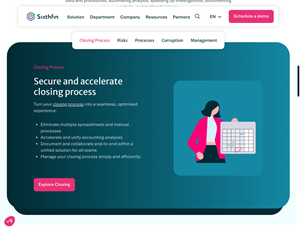
The Sixthfin platform accelerates and strengthens processes at every step: unifying data and procedures, automating analysis, speeding up investigations, documenting controls, and guiding decisions.
Legal Disclaimer:
EIN Presswire provides this news content "as is" without warranty of any kind. We do not accept any responsibility or liability for the accuracy, content, images, videos, licenses, completeness, legality, or reliability of the information contained in this article. If you have any complaints or copyright issues related to this article, kindly contact the author above.
